
Angry White Men – Explorations of the Face of Evil
David Haughton
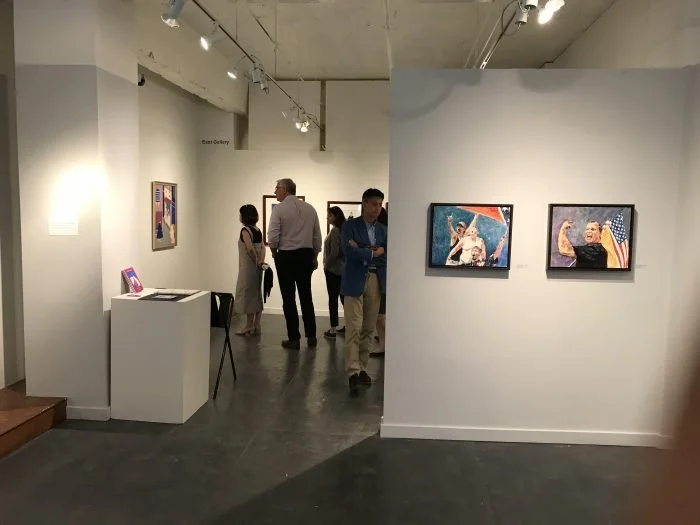
September 6 – 29, 2018, West Gallery
-
I confess that was I caught completely off-guard by the response from some viewers of this exhibit. Originally I had mild concern that alt-right fascists might hear of the show, become enraged, and threaten a brick through the front window. I never anticipated fury from people who think I’ve glorified the people I have painted.
What the images document is a rise in angry men globally. I think it vitally important that people pay attention to that. I know that I’m paying attention to that, which is why I’m painting these paintings. I think we all need to think hard about how we get out of this vortex of tribalism, nationalism and fury.
I have been working on this series, The Face of Evil, for over 20 years. Initially I simply gathered images of bad men, or evil acts from magazines, later from the internet. The images are all culled from photographs in mainstream magazines, newspapers and on-line journals, from collections on the internet. They have all been published. All are in the public domain.
I am exhibiting as I paint, getting reactions, comments and thoughts from viewers, expanding my plans for the whole series as new questions are raised. My first exhibitions of this work, Bad Men at Gallery 110 here in Seattle in October 2016, showed the first works of two sub-series “Mugshots” and “Evil in Disguise”. Those series were expanded upon in the exhibition Bad Men II in Vancouver BC in March 2017.
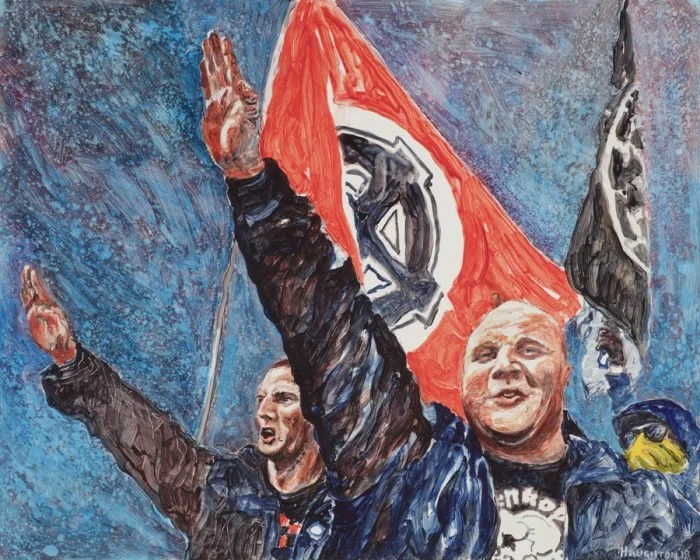
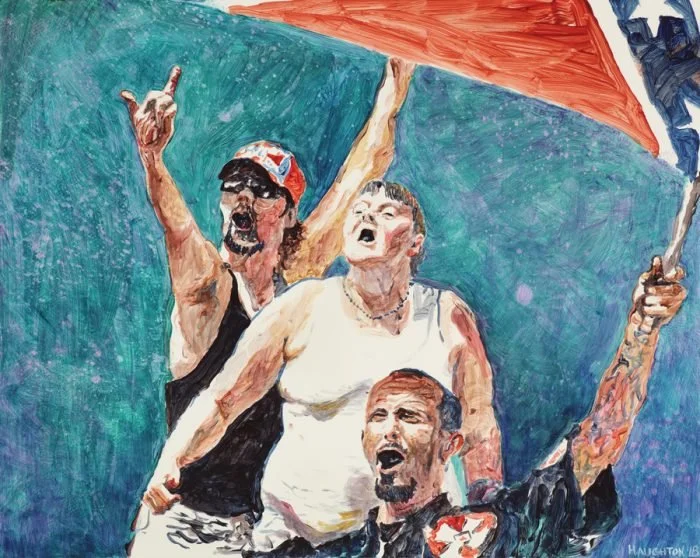
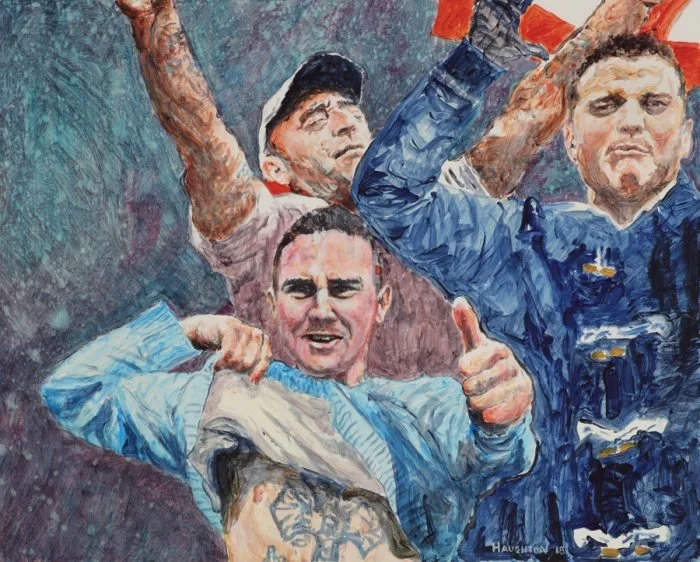
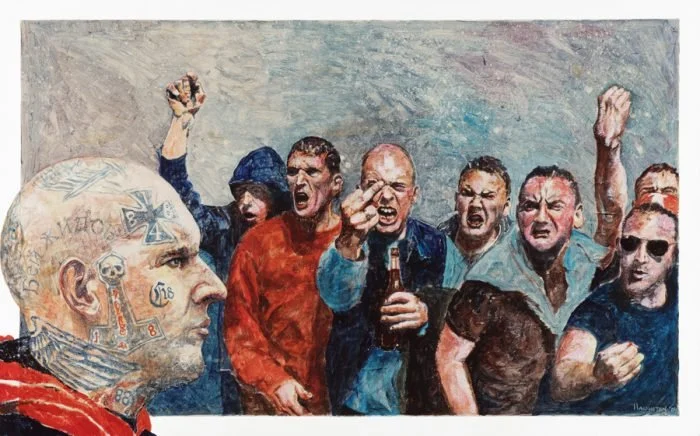
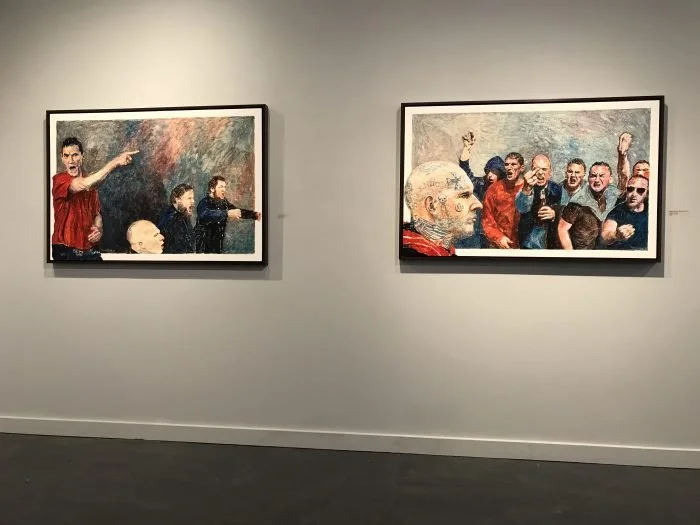
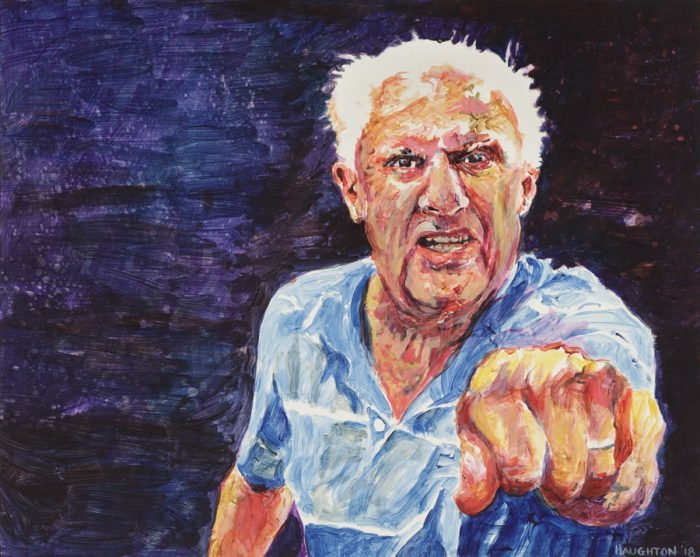
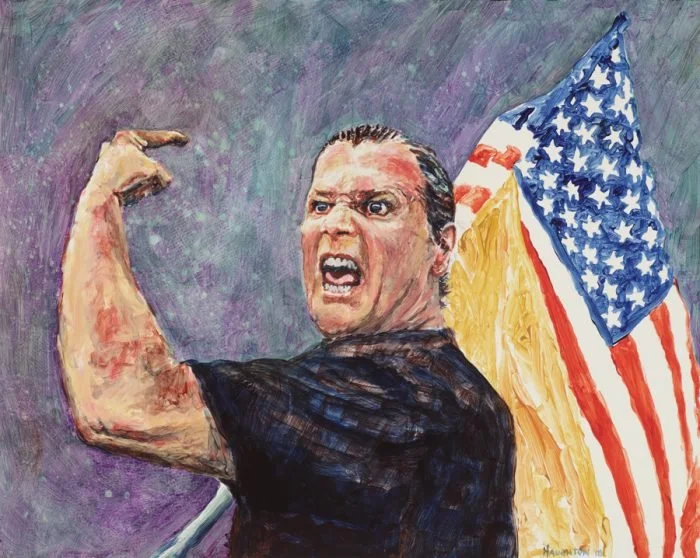
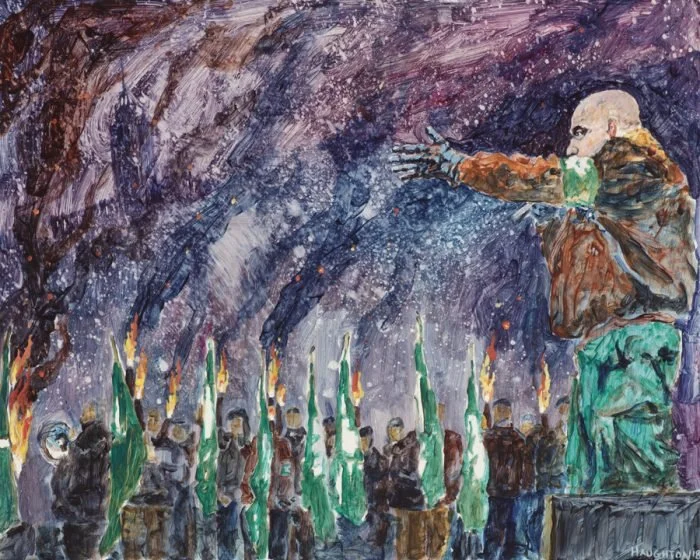
The series Angry White Men was inspired by the recent enabling of racism, anti-immigrant violence, anti-gay legislation, and the rise of the visible, public fascist demonstrator in the US and Europe. The paintings may simplify, but they do not distort or beautify the reality that is in the photographs – the perilous reality that we face in our world right now.
I confess to naiveté, to being woefully unprepared to prevent the complete misunderstanding of what I was trying to convey and the subsequent anger, shouting and threats.
• I had expected people to be repelled by the images, to find them “personally repulsive”, as I do. I did not come prepared with a manifesto clarifying what I thought people should think about the works and the exhibition. I value ambiguity and subtlety. I dislike being lectured by an artist or a curator. I believe that if an exhibition of art needs a long written or spoken explanation, the show is in trouble. What I have offered instead of didactic explanation is a multitude of quotations from others about anger, nationalism, the problem of human evil; statements that I hoped would catalyze thought to counter and layer the initial purely visceral reaction. I had expected to discuss their various reactions with viewers, and mostly I have been able to do so
• I have been criticized for having said that my choice of images was “arbitrary”. This left me open for misunderstanding and subsequent criticism. But I am speaking truth: the choice was arbitrary in the sense that, regrettably, perilously, the reality of our times is that there are hundreds more media images just like these.
• I did not provide “Trigger Warnings”. There is a long history of artists documenting evil. I believe that artists have a responsibility to reveal or highlight the brutal reality of their time. In the Prado Museum, none of the most powerful and difficult works – Picasso’s Guernica, Brueghel’s Triumph of Death, Goya’s Black Paintings – have signs warning the public of the power and brutality of the subject matter they are about to see. Given these images are culled from the public domain, that they have already been seen multiple times, it never occurred to me that the public would need a warning at the door.
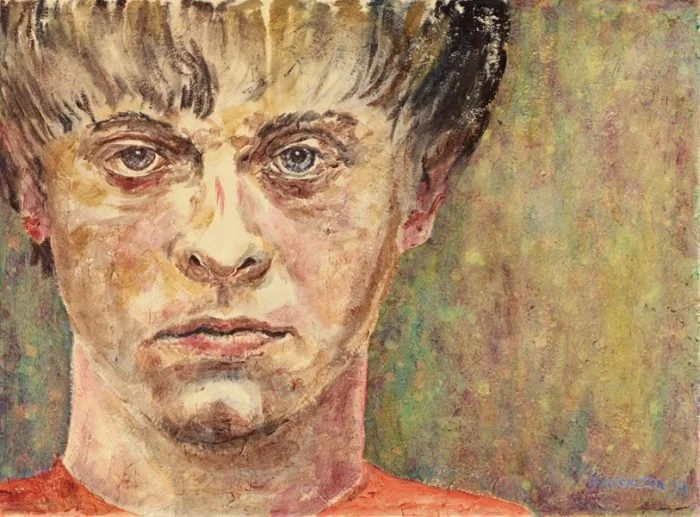
• I did chose to put prices on the works, not because I ever dreamed they would sell, but as a way of declaring that they have value as works of art. In three exhibitions, I have yet to sell any of these works. I am appalled by the thought of a person hanging such works in their home: it would be way too creepy to have intimacy with such evil. However, I had not considered several possibilities, and I am grateful that they have been brought to my attention, and sorry for the pain, upset and anger they triggered: I had not thought “what if David Duke or Richard Spenser offered to buy the work?” More concerning: “What if they attempted to buy the work through an intermediary?” “What would I feel if I actually was given money for a painting I had done of an evil man such as Brevik or Roof?”
As an interim solution, Gallery 110 posted the following:
The artist will donate all proceeds from any sales of the four large “Mugshot” portraits to the Equal Justice Initiative of Montgomery, Alabama. https://eji.org/about-eji. Prices for those works are now by request.
The artist would not, for any price, sell the works to any organization or anyone he suspected might use them to justify or glorify hatred, racism or antisemitism. Should a responsible public museum or foundation offer to purchase one or more of the works, he would have no interest in keeping the money. The artist did not expect anyone to purchase these works, at least not while he was alive.
I now realize that the anger over this point is distracting us all from a much greater existential threat: the rise of fascism and the inability of the different ‘tribes’ to set aside fury and listen to each other switching to shouting and invective.
Ultimately, it’s only paint on ‘canvas’, and we will remove all prices for the works.
-
Does the exhibit seek to aggrandize Nazis and/or sociopaths?
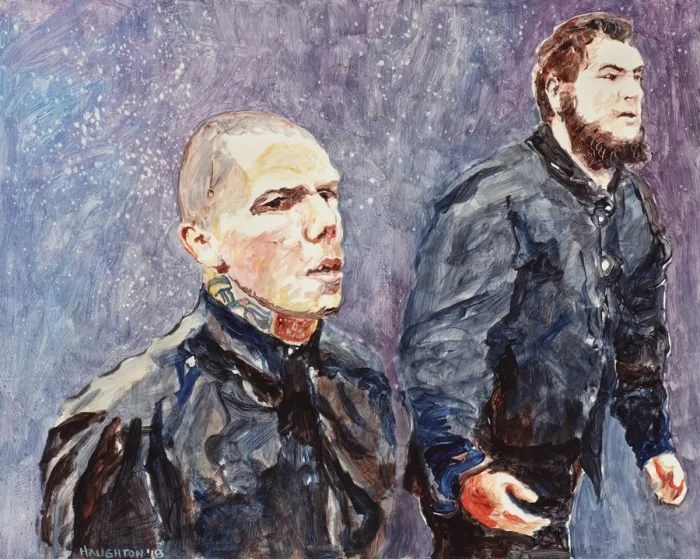
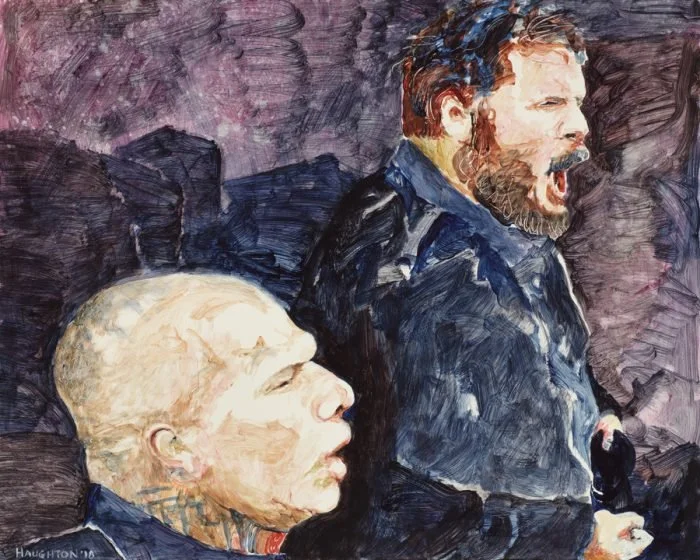
No. The images are all culled from photographs on the internet and are all in the public domain. They have all been published in mainstream magazines, newspapers and on-line journals. The paintings may simplify, but they do not distort or beautify the reality that is in the photographs – the dangerous reality that faces our world right now.The four large “Mugshot” portraits are acknowledged by the artist to be the most problematic of the exhibit: they depict the faces of four individuals, each of whom committed what the artist believes are truly evil acts. The names are intentionally not posted; visitors may ask for further information, should they wish.
Does the artist sympathize with Nazis, alt-right and/or sociopaths?
No. The full title of the exhibition is “Angry White Men: An Exploration of the Face of Evil.”The series was created to draw attention to online global protest. The artist mourns a global “regression to tribalism, to a loyalty limited to those of similar race, culture and political viewpoint, to a world-view that sees a threat in people of different religions and cultural backgrounds.” He is concerned about hatred between people based on colour, race, ethnicity, religion and country. The artwork seeks to document their hatred at a pivotal time in history.
His mother was in Athens during WWII. During the war, over 500,000 Greeks died of starvation while the Nazis shipped olive oil and food produced in Greece north to feed their troops. The artist’s grandfather put himself and his entire family at incredible risk by secretly gathering hundreds of photographs of starving children and of the scores of bodies stacked on wooden carts that trundled through the streets each morning. The world needed to know, he believed. The Gestapo several times raided the family home. At even greater peril, he successfully smuggled the images out to the Allies.
To quote former President Obama: “We’re supposed to stand up to discrimination, and we’re sure as heck supposed to stand up clearly and unequivocally to Nazi sympathizers. How hard can that be?”
But why paint Angry White Men? Why paint the faces of evil men?
This show seeks beyond all else to hold up a mirror for all of us to see a reflection of the world which we have created and which we perpetuate. Some may see themselves reflected directly; others not at all. But this is our reality. Our present. Our peril.Is it right that the artist “makes a profit” from depicting bad people?
The artist will donate all proceeds from any sales of the four large “Mugshot” portraits to the Equal Justice Initiative of Montgomery, Alabama. https://eji.org/about-eji . Prices for those works are now by request.The artist would not, for any price, sell the works to any organization or anyone he suspected might use them to justify or glorify hatred, racism or antisemitism. Should a responsible public museum or foundation offer to purchase one or more of the works, he would have no interest in keeping the money. The artist did not expect anyone to purchase these works, at least not while he was alive.
Censoring artists
Caving to censorship sets a poor and dangerous precedent for artists now and in future. The artist feels the works have value and he sees no reason to give in to threats of firebombs and shouted demands. There is clearly a chasm between the points of view about this project. However, people making assumptions and threatening ad hominem attacks appear to be deliberately misconstruing the work.
A new series of provocative paintings by artist David Haughton features portraits of neo-Nazis, livid gun advocates, and disenfranchised, resentful and angry protesters. Rich with texture, they capture the rage and violence of angry white men as they express their frustration, desperation and fear towards people who are not like them. The images are taken from news photos in France, Hungary, Bosnia, Poland, England, Scotland, Finland, Sweden, Denmark, Canada and the USA.
Haughton writes, "In depicting these awful people, I was not glorifying them and their beliefs. Rather, I was exposing the underbelly of US and European society. My goal as an artist was to depict, with unflinching honesty, the world in which we live.
This is the first of three planned exhibitions. It focuses mainly on portraits of the “angry white men” – men (and women) who mass on the streets: frightening, loud and looking completely capable of evil deeds. It also introduces four portraits of a second group of men who I call “puppets”. The “puppets” are men who have unquestionably done great evil (for example, Dylan Roof and Anders Brevik). They are also, almost inevitably, damaged men (mental illness and/or intellectual disability and/or disordered personality) who are driven to evil actions by embrace of ideologies of hatred, contempt and fear of people with different beliefs, cultures and skin color.
The later exhibitions in this series, in 2019 and 2020, will include more and larger portraits of these two groups, and introduce a third group, those I call the “puppet masters”. The Puppet Masters are the cynical, successful and intelligent white men who - with cold detachment - work through right-wing media and blogs to manipulate and profit from their more credulous angry white brethren."
“Decency these days requires the ability to stare barbarism in the face, repeatedly, randomly, intensely, without ever becoming inured to the ugliness of its features.”
— Jelani Cobb, The New Yorker
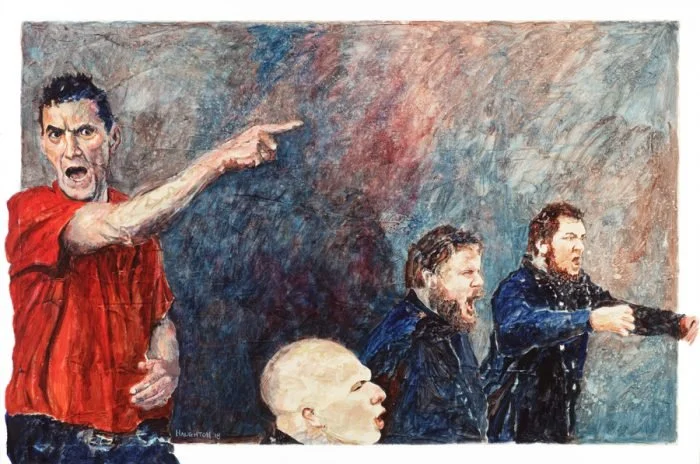
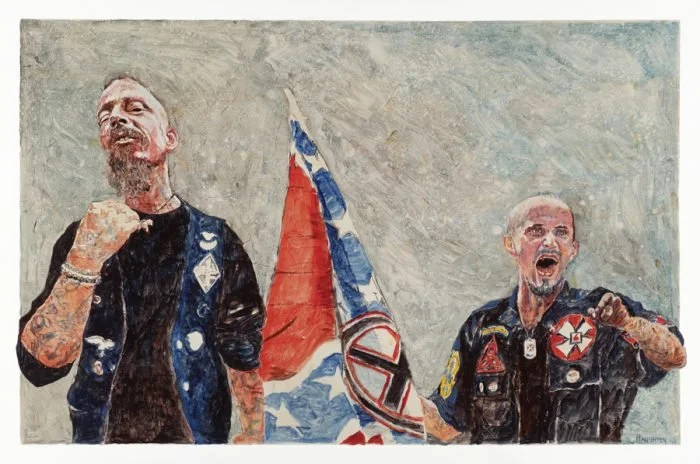
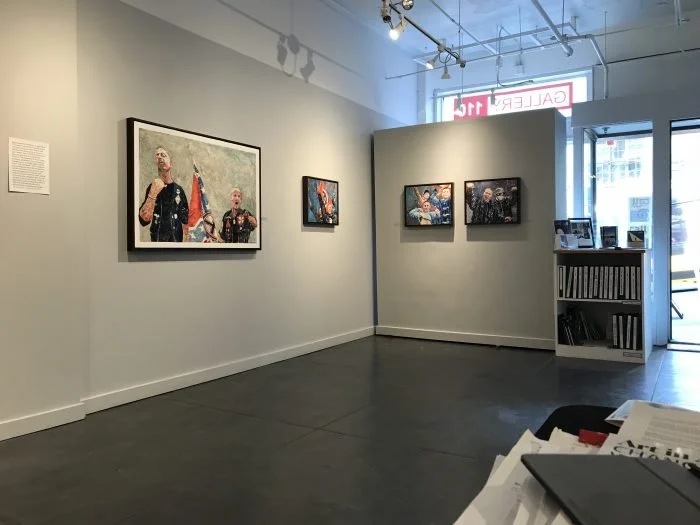
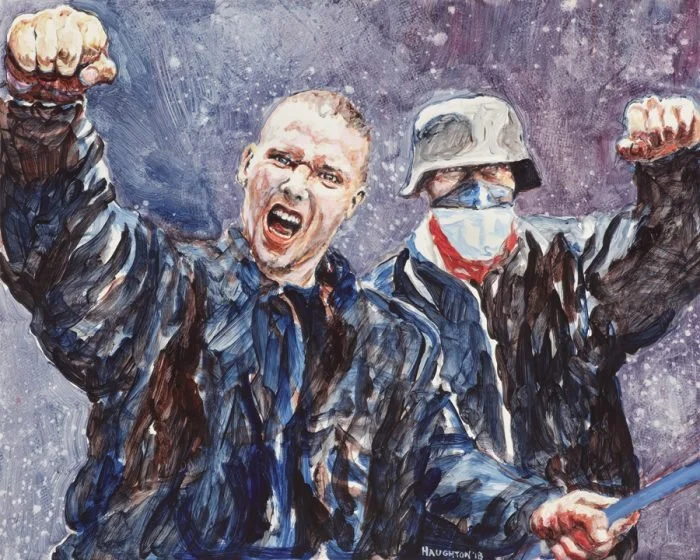
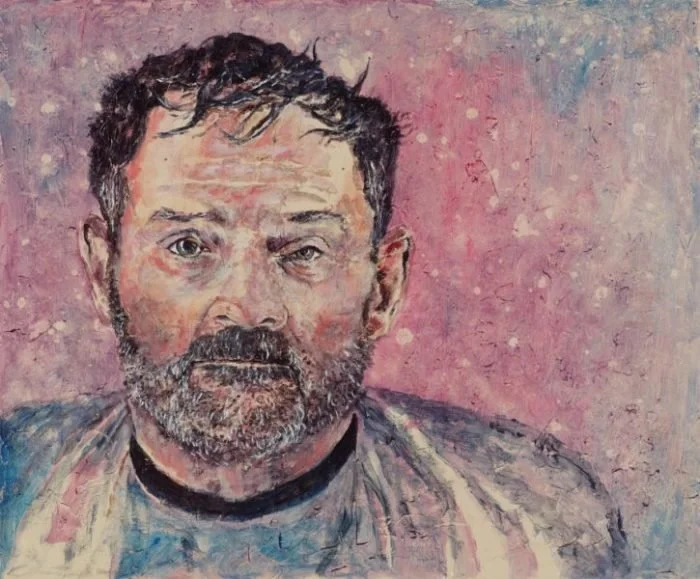
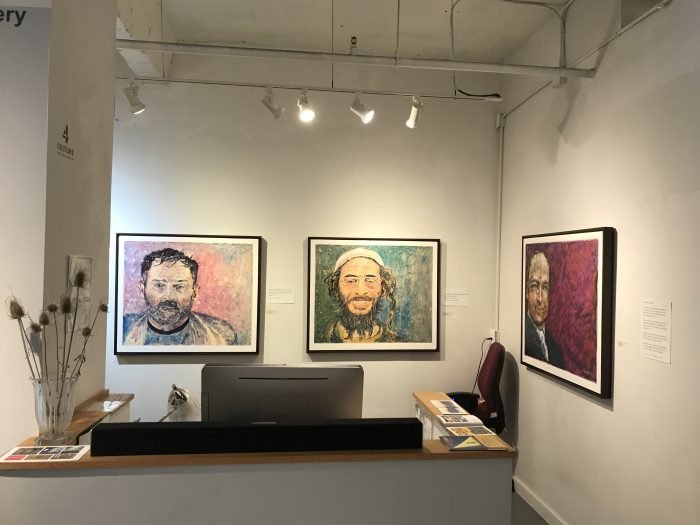
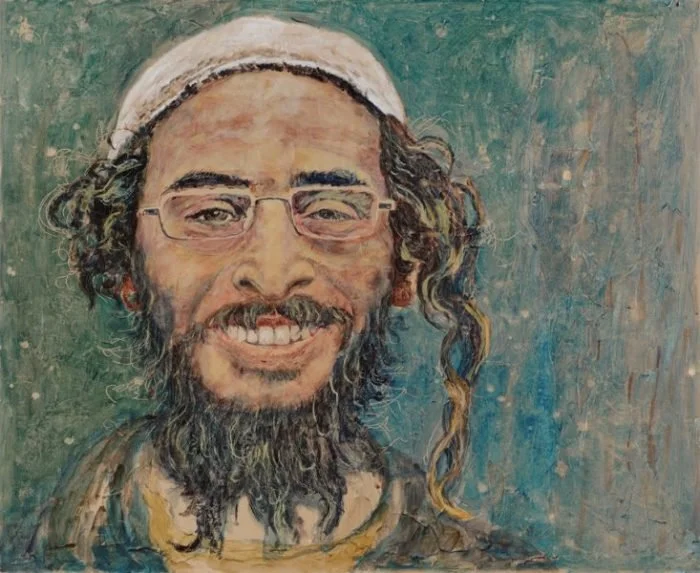
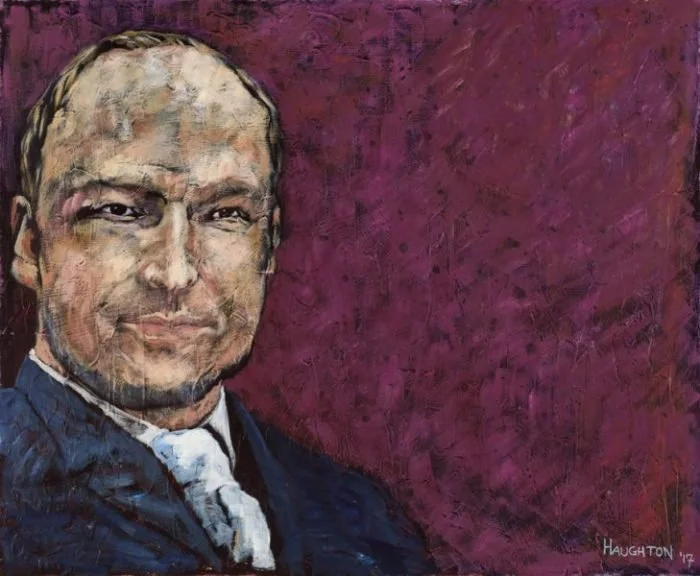
ARTIST STATEMENT
Everywhere I look in the news of the world, I see angry white men. Their towns have been hollowed out by the closing of factories or mines. The work done by their parents for a decent wage is now done abroad, and by machines and robots. Their insecurities are shaped into weapons by demagogues who blame the people who aren’t like them: immigrants, elites, liberals, democrats. Feelings of frustration and inadequacy are soothed by myths of an older, better time – a time when people loyal to their tribe or “nation” were honored, respected and rewarded.
Men and women lacking in, or deprived of, agency look to nationalism to assure them that, in their own way, they are as good as everyone else – better, even. It is just that the world does not give them the respect they deserve… [they] feel that the disruptions to the economy caused by globalization and technological change have increasingly rigged it against them. Their hard work – real or imagined – goes unrewarded while self-serving elites and the minorities who enjoy their favor reap privileged access to wealth and power. Bureaucrats obsessed with political correctness give immigrants jobs, houses and places in the local schools, while the nationalist’s loyalty to the nation, which is held to stretch back generations, is rewarded only by sneering and disdain.
The Economist – December 23, 2017
I am profoundly grieved and frightened by the rage and fear in their expressions, and the incoherent violence that some are driven to. “I understand a fury in your words. But not the words”. Men furious at Muslims kill Sikhs. Men attempting to murder Jews instead shoot Lutherans. Men whose fathers risked their lives fighting fascism raise their arms in Nazi salutes, join the KKK, and set elderly immigrants on fire.
I morn this regression to tribalism, to a loyalty limited to those of similar race, culture and political viewpoint, to a world-view that sees a threat in people of different religions and cultural backgrounds. But, as I paint these angry white men from France, Hungary, Bosnia, Poland, England, Scotland, Finland, Sweden, Denmark, Canada and of course, the United States of America, I can dimly see their humanity. The market reforms of the 1980s, globalization of trade, and particularly the technological advances of the last 40 years have enriched us all, but disproportionately so the elite; the sense that everyone is in the same boat has been destroyed.
I also understand that, given that in the right combination of frustration, desperation and fear, I might look like them. I, too, have ‘bred in my bones’ the capacity for fear, contempt, anger and violence towards strangers who look different, talk a strange language and now compete for the same resources.