
Juror Interview: Stefano Catalani (Part I)
The following is a transcript of a lovely conversation with Stefano Catalani, juror of the upcoming 15th Annual International Juried Exhibition at Gallery 110 and artist Shima Star, on behalf of Gallery 110. It has been lightly edited for clarity and length, and will be published in 3 installments leading up to the exhibition opening February 5th, 2026.
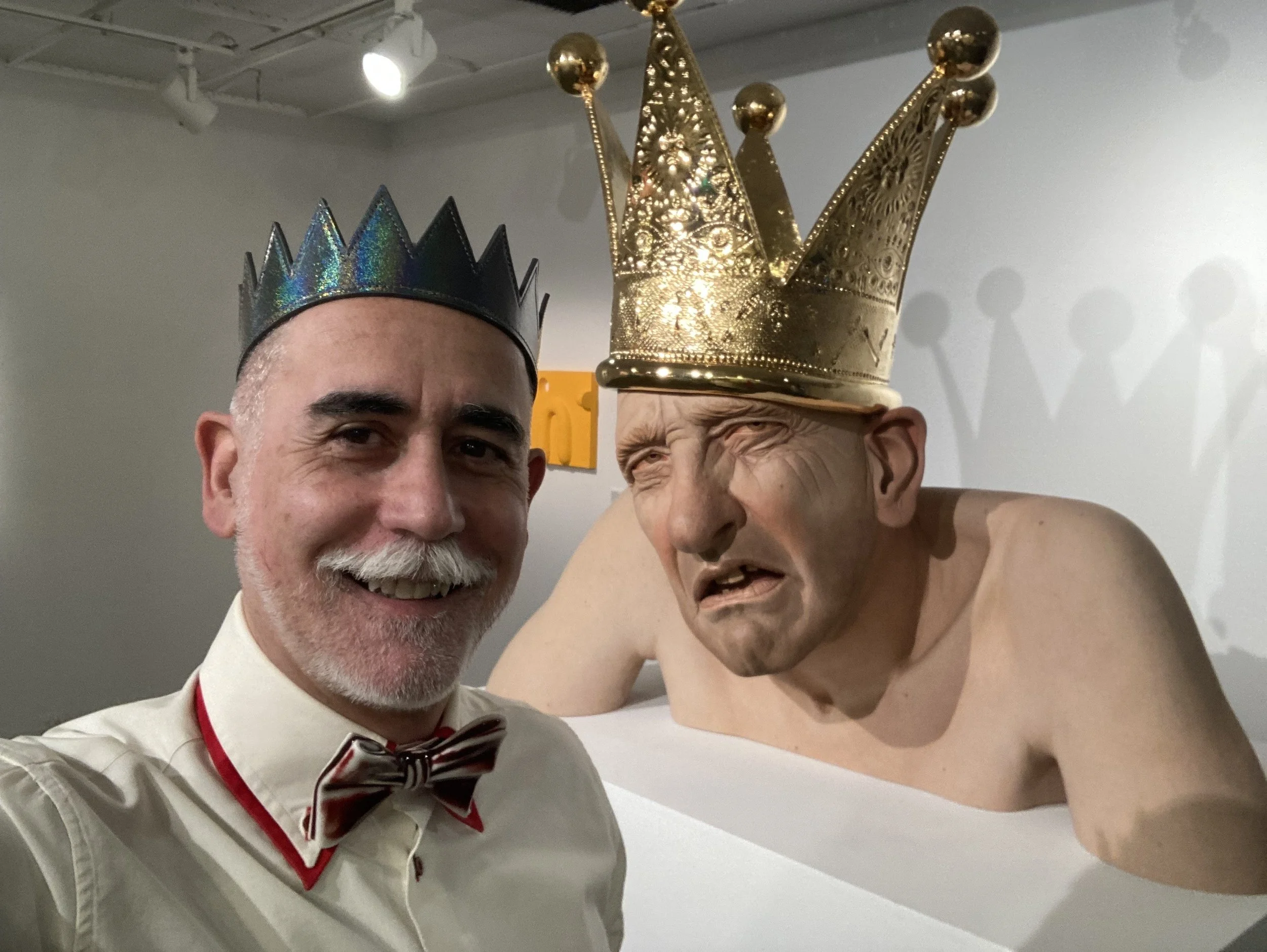
Featuring artwork by Tip Toland
The Greedy King (detail), 2021
Stoneware clay, glaze and luster paint, chalk pastel
54" x 57" x 43"
Shima Star
It is my great pleasure to present my first interview on behalf of Gallery 110, a cornerstone of Seattle's vibrant arts community.
As we prepare for our 15th International Juried Exhibition—a tradition that has celebrated artistic excellence for over a decade—I’m honored to have this conversation with Stefano Catalani, a visionary leader whose influence spans museums, arts education and curatorial innovation.
Stefano's journey from a small town outside of Rome, Italy, to the Pacific Northwest is as compelling as his contributions to the arts. From his transformative tenure at Bellevue Arts Museum to his current role as Executive Director of Museum of Northwest Arts, Stefano has consistently championed creativity, accessibility and dialogue within the arts.
Today, we'll explore his earliest inspirations, his approach to jurying for Gallery 110, his upcoming role with the Smithsonian Crafts Show, as well as his insights for artists and curators alike.
Welcome, Stefano. It's a pleasure to have you here and to have this opportunity to have a conversation with you.
Stefano Catalani
It's a pleasure, Shima.
Shima Star
Could you share some of your earliest memories of the arts that sparked your passion within this field?
Stefano Catalani
I think my earliest influence has been my Dad. Professionally, he was a lawyer; he is retired now. When he was young, he was an amateur plein air painter. Here—where I am now—is his condo in Italy. Growing up here, he had a lot of his paintings hanging around, together with paintings from other artists that he collected and followed.
In this environment, he often would stimulate me and my brother about looking: “What are you looking at?” And, how to look at the picture or painting and ask: “What do you see?” I think that is what made me curious, but also acquainted with the language of painting and the visual arts. When I look back, that's what really has inspired that curiosity for me initially. He would take me—not so much to museums—but to openings of other painters that he admired. At the time, I didn't like to go very often, because I was maybe eight or ten, and my brother was five. He just made me feel comfortable in that environment and comfortable around painters and artists. For me, painters were artists at the time. I only had that, you know. So, yeah, looking back, I think that's probably where I developed both an acquaintance and a curiosity for this language.
Shima Star
Wonderful. Thank you for sharing that. What was the first artwork or cultural work that truly moved you to really {go} further in this direction of working within this field?
Stefano Catalani
That moved me? It was two works. I still remember them because this was actually the beginning of my career. Two Australian artists, two photographers.
Tracey Moffatt: there was a photograph probably taken on Bondi beach in Sydney, Australia, of two young children in a Volkswagen. I mean, it's hard to describe. It was a photograph along the beach with the ocean behind. And there is this van, this Volkswagen van with these two kids that seem very worried about something—they are banging against the glass trying to get out. In the foreground, there's two women kissing. It still remains one of those conundrums because, the first thing you think is that maybe the kids were forgotten inside the van by these two women, but then looking at the photograph there were other things that were happening. It was a little bit of a journey of discovery. That photograph really got me excited about photography, which was what I started curating with when I was in Rome.
Then Maria Zopardi, also an Australian artist, and the first artist I've ever curated an exhibition for in a public space. She is a photographer who did a 1996 residency at St. Joseph Hospital in Sydney, New South Wales, which was an hospice for terminally-ill AIDS patients. She gained the trust of those patients in their last days and {they} allowed her to photograph {them}. I showed those photographs both in Rome and in Malta. And I actually own two. I was lucky to purchase them 30 years ago now. They are very powerful images. As a gay man, for me, especially at that time, those photographs were a threshold in terms of the unknown, because although the {AIDS medication} cocktail had just been invented, it was just the first steps. So many people were still dying. It was also a threshold in terms of introducing me to politically and culturally committed partisan photography, I would say.
Shima Star
That's really, really very interesting. This feels so personal and very close to you. I am interested in how you've pivoted from your early experiences into arts and crafts?
Stefano Catalani
Well, America happened. I moved to Seattle in 2001, so this year will be 25 years. And although I was open, I was trying to create a career in Seattle, writing maybe for The Stranger. (It never happened.) Writing for galleries, writing catalogues for artists, I was trying to put forward my services as a writer. But also in those first years until 2003, I felt—which of course I have to be very careful today because the culture has changed—but I felt that there were a lot of stereotypes about being Italian that were projected onto me. Some of these stereotypes were very endearing: apparently, Italians are great lovers and we know how to cook. But I sensed and felt it on my own skin that there was some sort of a system that was framing me in a specific way. For example—another sensitive thing to say—somehow my cultural difference was being erased. As {an} Italian coming from Italy and an Italian-American, which is not the same, though I respect, of course, the cultural heritage of all the Italian-Americans.
There was a simplification or an oversimplification that was being made—which is a stereotype, every stereotype is a simplification and oversimplification—and I felt that I was being sort of pinned on the wall in a box for insects in a specific class. It really moved me to start looking at artists, that's really who I curated for about 10 years when I was at Bellevue Arts Museum. I started writing about artists that were maybe not necessarily trained as craftsmen. They had not necessarily developed the skills initially at the beginning of their careers as craftsmen. But maybe because they had relocated from one country to America or from one country to another country—a Western country—they had reclaimed craft as a language to express their own individual identity.
So I literally befriended a lot of these artists. Like, for example, Ah Xian, a Chinese-Australian artist who left after Tiananmen in 1989, {and} moved to Sydney. He was trained as a social realist painter in China. When he moved to Australia, he embraced porcelain, which is quintessentially associated with China's culture, to express his Chineseness, to reclaim his Chineseness, because he was banned. He couldn't go back to China, not even for the funeral of his mother, who passed away like 10 years after. So I was interested in this artist interested in the language of craft as a vehicle to express their own cultural and personal identity.
My most interesting exhibitions were with artists that were displaced or, like me, had immigrated from one country into America or a Western country. Ed Pien, who's Taiwanese {and} lives in Toronto, Canada. So that was the initial impetus, the initial driving force for me. Looking back, I think I benefited from two things. My own personal passion for the art and for understanding how craft really could become a language to express individual identity. I see myself as a vehicle, as a conduit. Also, I think of different cultural times today and I'm not, you know, decrying this—I think I would be much more cautious as a white man. I think it would be much more suspicious today to befriend artists that are coming from minorities in America or around the world and allow them to express who they are through the medium of craft, because today there is this idea of an imbalance of power dynamics, which I recognize. Always, as I said, all these people are actually my friends and we really established deep, deep relationships of friendship so that we could really understand each other.
Craft is often associated with traditions, and traditions are associated with identity, both cultural and individual. Mostly cultural. These artists appropriated, reclaimed, learned from zero, sometimes from scratch, these crafts to express who they were, where they came from, and sort of assert their uniqueness, difference, diversity. I would say difference within the landscape, you know, the cultural landscape, which is very homogenizing here in America. It tends to homogenize. I think that was the impetus.
After doing maybe 10 exhibitions I felt like I had written enough, I had published enough, presented to enough conferences—and I felt that it was becoming a little bit of a shtick. I had addressed this idea of craft as a signifier of personal and cultural identity. That's when I really stepped back and decided to just be Director of Curatorial Affairs and have Nora Atkinson or Jennifer Nava Milligan (my two best curators ever) who went on to, of course, to have much more glorious careers than me. To take the leadership at the Museum in terms of curatorial programming {meant} I would be there orchestrating, directing—but not physically engaging with the artists.
Shima Star
There are a couple of things I really found interesting in what you've just shared because I have noticed it myself. I'm sort of well-traveled—from India to Africa to the UK and now we're here—three generations removed. What I've really noticed about our particular scene is that I sometimes feel that it does push us to go back to our roots; there’s almost a sense of “you have to tell us who you are.” Some of us have such an eclectic background. How do we describe all of this stuff? So I'm really interested in what you just said, because I really feel it personally, when I'm looking at the scene and figuring out our space and my place, and I am sure many artists are coming from diasporic experiences. It is sometimes a little bit uncomfortable to be pushed—in some ways—back to find a sense of acceptance, even.
Stefano Catalani
I mean, for me, I was working with artists whose existence, both personal and artistic, was at the seam between two cultures. One who passed away last year at 57, my very own age. He came as a refugee, when Cambodia, the Khmer Rouge, invaded Vietnam. He showed at the Venice Biennale. {Ed Pien} graced me with this idea of doing a show because I was the only one of few curators who realized “oh, you are weaving these photographs with a grass mat weaving technique that you learned from your grandmother, not to create beautiful aesthetic elements, but because it remembers your own roots when you were a child—you were helping your grandmother weave grass mats.” He was Vietnamese, became American, and then later, once he became famous here in America, he returned to Ho Chi Minh City and had to relearn the language. He was always sort of at the threshold. When he came from Taiwan to Toronto, his father basically told him you have to abandon your Chinese name and, you know, take an American name because no one will be able to pronounce your very difficult name. And so again, that's another threshold that you have to cross. And as an artist, he was marked. All his work is actually very liminal. It exists between appearing, looking, seeming something and not seeming.
So I was interested in these artists that {experienced that} pressure when they embedded themselves into the Western culture, whether Australia, Canada, or United States. And then, of course, they were re-appropriating crafts as a way to express their own cultural identity, but not necessarily. I work with gay artists who, for example, use crochet to very much defy the stereotype that if you were a gay man, you're a woman trapped in the body of a man. And so: why don't you crochet? What is a ‘quintessential feminine activity’? Crocheting. So he actually made this incredible room, life-sized room, sculptures of a locker room for men with urinals, all crocheted and I showed that at the museum. The whole idea was masculinity, the temple of masculinity, a gym where men go and shower after working out very hard and also measure each other up—but then it was all very feminine. It was all crocheted. It took him seven months to create this installation. So I was interested in artists that were appropriating craft or reclaiming craft as a way to express their own identity or defy cultural, societal expectations. So that's really been the best part of my career. I truly enjoyed it until one day I woke up and it was gone. I didn't want to do it anymore. I had said all I had to say.
Shima Star
This is so beautiful and really deeply moving. I can relate personally, I'm listening and connecting to everything that you're saying. I often wonder, maybe I should ask more of our peers: does the environment of the art scene push you to explain who you are? That's not always where you are in your practice. Some of us are a—shall I call it a puddle?—a puddle of everything in terms of diasporic experiences.
—————————————————————
Stay tuned for Parts II & III of this interview, where Shima and Stefano get into the methodology of jurying our show this year, advice for aspiring artists and curators, and exciting projects coming up at the Museum of Northwest Art and the Smithsonian!