
Juror Interview: Stefano Catalani (Part II)
The following is the second part of a transcript of a lovely conversation with Stefano Catalani, juror of the upcoming 15th Annual International Juried Exhibition at Gallery 110 and member artist Shima Star on behalf of Gallery 110. It has been lightly edited for clarity and length, and will be published in 3 total installments leading up to the exhibition opening February 5th, 2026.
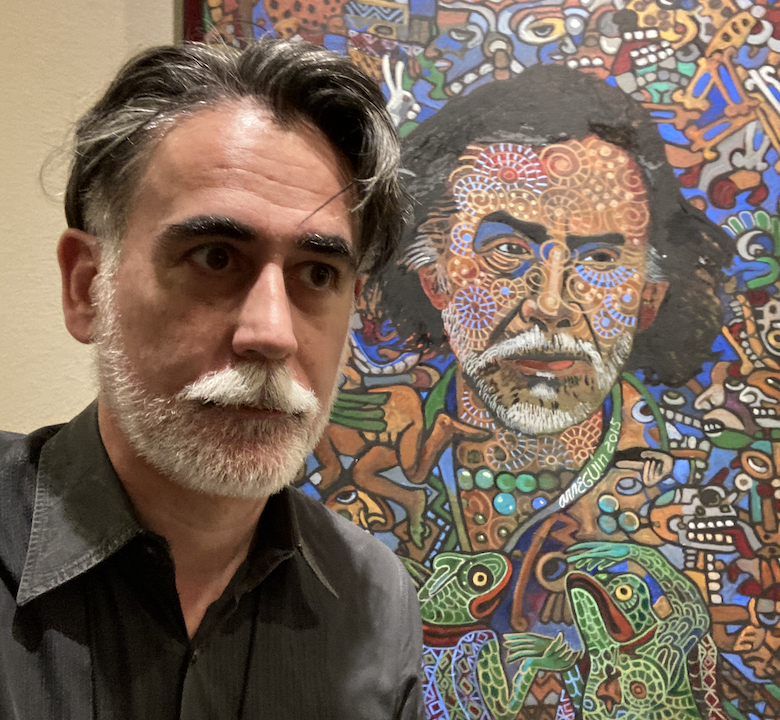
Stefano Catalani
Shima Star
We are going to pivot towards the Juried Exhibition that you will be curating for us at Gallery 110. This was an open call for work with a wide variety of subjects and mediums. Can you tell us about your mindset or approach when reviewing and selecting works for this show?
Stefano Catalani
This was a monumental effort. I didn't realize that there would be 1,600 entries, and I was very diligent. I actually started on the first day when I was given access! I said, every day I have to do a certain number because there's no {other} way to do this having a full-time job and a life. I was very proud of being so diligent and also by dividing the labor, it allowed me to give every artist the same attention. I went in with eyes wide open. I always look attentively. I make sure that I gave every artist with their entries the time.
If my first impression was {that} my curiosity was captured, I knew there was something that I wanted to return to. I spent more time with those artists, maybe comparing the entries, sometimes more than five, to understand if there was a narrative, a technique, a style or some sort of approach that was common, then choosing the best one that I felt that was {most} interesting. But mostly I went with eyes wide open, looking attentively, open to being surprised, trying to be aware of the obvious.
We live in very polarized time, especially in the last 10 {years} and I think art is being pushed to the edge of propaganda sometimes. Also, there are some political expectations from art. I'm not going to go into the merit of those expectations, but I feel that sometimes they can be detrimental if they reduce the work of art to a simple equation, one plus one equals two. It's all there—there is no mystique, there is no mystery, the aesthetic and compositional elements might be disregarded. So I was trying to be aware of the obvious, and I was trying to keep my eyes open and look at the picture attentively to be surprised, to be taken by hand, to be interested, to be fished out of my own status and drawn into something else.
There were very few yeses on my first round, and a lot of maybes. I think there were maybe 200 maybes and then, of course, a lot of nos. But, you know, that's the name of the game. I went back to those maybes in the last week, and I really took my time to understand: why did I put that as a maybe? What do they do to me when I look at them?
I did not give myself quotas. I didn't say, “oh, maybe there should be a representation of everything.” If a category is strong, a category is strong. That's the sign of the time. It means that genre or that medium is stronger than others, at least for this occasion. I felt it was an incredible opportunity to engage so many artists on their own terms, on their own turf.
It's a conversation that we're having through a screen, unfortunately, but it's wonderful—my vision was expanded. My knowledge was expanded. It's an opportunity to expand your own cultural battery. I never say no, because I'm a curious mind and I always want to know: What's up there? What are they doing? What are people creating? So yeah, that was my mindset.
Shima Star
Were there any trends? Was there anything specifically that you were seeing that artists were doing?
Stefano Catalani
One thing that I was very impressed with was that I thought photography was very strong. For the first time, there was not so much of that cheap digital photography, manipulated. There was a lot of return to the craft of photography, of darkroom, albumen prints. I was very interested in this idea of a return of the skill of making a photograph, engaging with the negative and the printing process, the ability to achieve some results that you can only achieve by printing rather than in the darkroom or manipulating the chemicals. I thought there was a little bit of a return of early modernist photography with attention to the abstraction of forms. I thought it was really beautiful. I think actually the show will have some good examples.
Again, as I said, I went with open eyes. I didn't say, “oh, this has been done 100 years ago.” I'm always saying, “well, yeah, it's been done, but not in this way, not with this architecture.” There was a lot of architecture. Also, it's interesting to say, but why is there this return? After post-modernism and this sort of meta post-modernism in which we lived for a while, maybe there is an aspiration to some grand narrative to return—a positive one, hopefully, not the monster of fascism that modernism created in the 40s. It felt like a litmus test. I didn't have to come and say, this is what we're going to do. Also, 1,600 works didn't allow me to do that. It was such an overflow—I couldn't impose or superimpose. Photography was very rewarding, I would say, and I'm really looking forward to to seeing the show.
Shima Star
Yes, I'm really excited to see it too! You've got this generation that is in between where we didn't have technology and we have technology. I'm really interested in Gen X and Gen Z, what are they doing as a whole? We were doing all of the photography in art school, and then we're moving through with this new technology. What is this generation doing with that? How are they using and incorporating all of this knowledge? It's going to be another decade or so before we really can look at it.
Stefano Catalani
Yes, I agree. As we are speaking about technology, I found that there was some artists that are returning to the low-fi, the analogic or the raw materials. One artist, for example, entered into the show drawings of computer screens with windows—when you open all the different windows and you superimpose them, but these are drawings, not snapshots. There is a quirkiness, a sense of discipline in doing this futile thing in itself. Also, it's a daily image that you might see that is so menial and overlooked, but then {they} elevated it to artwork or subject of his or her artwork. It really captured my attention about the time that went into making these drawings.
The other one is {an} artist that uses party balloons and raw construction material to make tableaux that are very raw looking, but also have some sort of mysterious, undecipherable messaging in it (and purposely, I think). I thought that there was a return to the rawness of the materials, the found object, that I thought was—not a rejection of technology, but this idea of getting your hands dirty, of doing things with your hands. I don't think this is a trend, to go back to your initial question, but these are works that I thought were interesting for me. They captured my attention.
Shima Star
Yes, that kind of technology and skills that we would have had in the past, bringing them back into contemporary conversation. Do you have any advice to give artists who are thinking about applying to future juried shows?
Stefano
First of all, because you know that the show is going to be juried on a computer screen—please, please, please pay the utmost attention to the quality of your photographs. It's critical! That's your tool, your avenue to get {a} juror's attention. Invest the time and the money, but mostly the time, in having good quality photographs—museum quality or publication quality. You don't have to pay a lot of money for a professional photographer. You can set up at home, but it's critical.
“I don’t think the artist should try to replace the critic. I don’t think the artist should try to force onto the audience or the critic or the juror what they are trying to say. For me, there are so many things that an artwork says, but also so many things that an artwork does not that are also relevant and critical.”
You have so much competition, there are so many entries, and there is only so much time and attention span that the eyes of a juror might have. Trust me, after seeing 100, 200 images in a row, everything starts to look the same. The flaws then emerge fast to the surface! So if something looks ugly, I say no—and that's a missed opportunity for me to engage with your work. So photography, really, presentation.
Also make sure, and this is my own pet peeve, make sure that your artist statement is not the work of art. If the work of art needs an artist statement as a crutch, beyond the title, then I think there is a problem. I think this is a bigger problem and I think it finds its roots in academia. We are creating a generation of artists that need to express themselves and so they're asked to not only create the work of art but also create a fictional piece of literature which is called the artist statement, and that basically has to explain what I'm supposed to see in this picture.
I don't want to be told what I need to see. I want that work to engage me sensually, intellectually, emotionally. Let the work do the work. If the work doesn't do the work, having an artist statement as a crutch to prop it up doesn't work for me. You should invest your energy making the work of art and not spending a lot of time writing—I’ve been saying this for 25 years, all my career—fictional works of literature. They're fictional and also they're very controlling, trying to tell people “this is what I want you to look at.”
I think that's a strategy that capitalism and marketing have been using for generations. Why do we have a generation of artists trying to apply the same methodologies to force upon the public the idea that “this is what you need to look at. This is what my work is telling?” That diminishes the art for me, and it constricts me. It doesn't allow me the opportunity to engage, as I said, sensually, emotionally, intellectually with the work.
Some artists had very cerebral, lengthy {statements}, which I appreciated. But then, of course, if the work of art cannot carry the weight of what you're saying in words, then it's a {sad trombone} moment.
Shima Star
I do feel like—and I'm pretty sure many of us do—that there is a pressure to explain yourself. How can you always articulate what it is that you are making? So, ease off artists on your statements, you don't have to do that to yourself—you don't have to produce a huge wordy explanation or justification of your work and why you're doing it?
Stefano Catalani
Where's that coming from? When Duchamp showed Fountain in New York—a urinal basically—there was no explanation. The piece was really disruptive and is considered by many as a critical moment of modernism and the birth of the artist as the idea-conceiver rather than the maker. There was no lengthy statement about it. The urinal, simply changed in its angle and signed R Mutt, clearly perforated through the social pretension and insulted many and made others laugh. Whether they took it as an outrageous slap on the face of the canonical art or instead as a {declaration} of what the role of the artist is, we're still writing about it.
I don't think the artist should try to replace the critic. I don't think the artist should try to force onto the audience or the critic or the juror what they are trying to say. For me, there are so many things that an artwork says, but also so many things that an artwork does not that are also relevant and critical. Again, while you're pointing the fingers at the thing that you want me to see, that could be a distraction from the things that you don't even know that unconsciously you're embedding in your work.
I'm not saying you don't have to have an artist statement. I'm just saying do not overdo it. Do not explain. Do not overdo it. As I said, if your work of art does not carry visually what you are putting in words, then you have an anticlimactic effect for me. I honestly think any seasoned curator would read through the lines and see through you. If the work is thin, you cannot buff it up and make it thicker with words. Don't overthink or over explain because you're robbing me of my own experience with your work of art.
—————————————————————
Stay tuned for Part III of this interview, where Shima and Stefano continue with further tips for aspiring artists and curators.