
Juror Interview: Stefano Catalani (Part III)
The following is the third and final part of a transcript of a lovely conversation with Stefano Catalani, juror of the upcoming 15th Annual International Juried Exhibition at Gallery 110, and member artist Shima Star on behalf of Gallery 110. It has been lightly edited for clarity and length, and will be published in 3 total installments leading up to the exhibition opening February 5th, 2026.
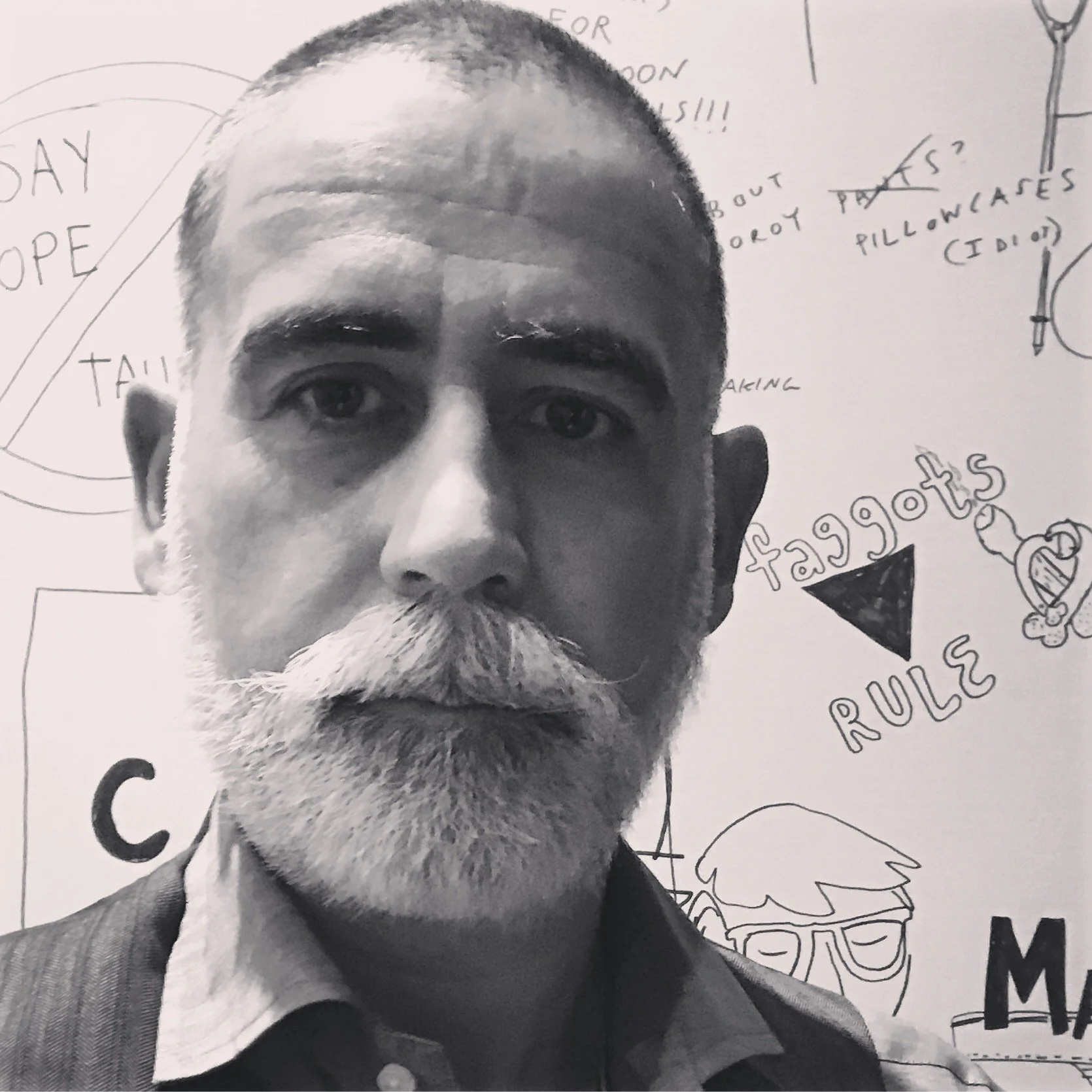
Stefano Catalani
Shima Star
Do you have any advice to give to aspiring curators and artists interested in stepping into either the role of a curator or potentially being a juror? What's wonderful about Gallery 110, as a collective and a community of artists, is that we get the opportunity to curate exhibitions, if {we} choose to. What lessons have you learned from your past experiences?
Stefano Catalani
Be true to yourself. I can only speak for myself; I cannot speak for anybody else. As Oscar Wilde said: "you can only be yourself, everybody else is taken." So be true to yourself. If you have an idea and you believe in it, go for it. Knock at the doors. I always say, if you're outside a door waiting to knock, nobody knows that you're out there. Nobody's going to that door. You need to knock. They like you, they let you in. They don't like you, there are other doors.
For me, being passionate about what I do is actually the fiber of my own existence. I couldn't be doing something that I don't believe in; I need to live and breathe and feed on what I what I love and what I like and what I believe in. My ideas are my treasure. As a curator, I found my vein and I made it into a mother lode simply because I was able to tell the story in a way that resonated with the public. If you know what your vein is, if you know what your story is, then you're already 50% {there}.
Then you need to make yourself an entrepreneur, a marketer. You need to knock at the doors. You need to meet the artists, go into the studio, introduce yourself. Don't be shy, just be humble. Don't impose your ideas onto the the artist's ideas. You need to be looking. You need to be listening. You need to be open. Does it fit your project? Great. Does not fit your project? Well, maybe not this project, but you'll learn something about this artist, and maybe there is another idea. Or maybe this artist doesn't interest you, but you might still support them. So that's all I say. I say be true to yourself.
I think that it's sad if you become a curator because you think there is some social cachet with it. I've known a couple of curators who were more caught in the machine of the museum world more than their ideas. At the end of the day, if they can live with that, that's great. I couldn't. I need to live with myself and I need to do what I love. So that's my only advice, be true to yourself and be always out there meeting artists and engaging with their work and trying to understand how does it fit within the cultural sensibilities of the times in which we live.
“If you have an idea and you believe in it, go for it. Knock at the doors. I always say, if you’re outside a door waiting to knock, nobody knows that you’re out there. Nobody’s going to that door. You need to knock. They like you, they let you in. They don’t like you, there are other doors. ”
Shima Star
I love that. I really do. My takeaway from that is just get out there. Just do it; you’re never really going to fail. You're just going to get to knock on another door. I love that so much.
Stefano Catalani
Nobody likes to fail. You know, I'm an amateur potter and I can tell exactly what I'm really good at throwing on the wheel and what I'm not good {at}. And guess what? Every time I sit at the wheel, I end up doing the same thing, because I know that I'm good at it so that's self-validation. But then, of course, my teachers say, “OK, you've got 2,400 of these, but I haven't seen you do anything else. You're in a rut.” The moment that you came out of your rut, you realize “oh, God, this is not coming the way I want it. Oh, this is so ugly. This is not me.” But you don't grow if you don't stretch yourself.
Of course you don't want to fail with a curatorial project. As an artist or curator, you want to engage with your ideas—it’s important to bounce your ideas. We always used to say at Bellevue Museum, every year you get 20 ideas of amazing shows. But the moment that you start to verbalize, the moment that {you} sit down in a room around a table and talk about {it}, if you couldn't sustain the conversation for more than 15 minutes, the legs of that idea were very short and very weak and all of a sudden would collapse. So just talking about it, bouncing your ideas with others, they ask you a question like “wait a moment, I don't understand. Are you trying to say this?”
Then that becomes a dialectic process that allows you to prove, strengthen, or discard. Say, you know what, that was a great idea, but apparently it's not good enough. It's not going to work.
Shima Star
For the artists approaching curators, give us some tips on the best way. And when in your career should you begin to approach curators?
Stefano Catalani
The best way to do it for me is to go out, go to First Thursday, go to the gallery, seek out the opportunity to engage with a curator. When I was at Bellevue Museum and even now at MoNA, receiving packages in the mail with letters and printed materials or CDs doesn't work. You get a lot of competition. Staff is very thin. It gets two minutes attention and then it's gone.
I think instead if you are able to meet with the curator and if you start to enter shows, you are part of a gallery or a co-op, that's when you need to disseminate your work and create opportunities that are opportunities with engagement with curators. Sometimes I don't even meet the artists, I meet the work of art and then say, who's this person? Ask the gallery, “Can I have the contact?” Every time you show your work is an opportunity to meet a curator. That's how I see it.
Shima Star
Get out of your comfort zone, artists, and get yourselves out there! What are you excited about next?
Stefano Catalani
Well, in general, I'm excited about Museum of Northwest Art. January 1st, I started my fifth year, which I cannot believe. You know, I'm trying to rebuild the museum after they hit a rough patch, and {it} is going really well. I'm repositioning the museum as a museum that really exists at the seam between the past and the present, like every museum, but also between different cultural areas.
We are sitting across from the Swinomish Tribal Community Reservation. Skagit is home of 22% Spanish-speaking population. We have a huge Native American population. We are a coastal area, but with the mountains, the Cascades just behind us, are huge environmental issues. So the museum is actually very local, but in a way is able to express global concerns, whether environmental, cultural, {or} the polarizing element of the modern contemporary politics. The museum is really placed in an incredible moment in time and space to be able to engender and embody the many different voices. I'm excited about that.
On January 24, we are opening Nancy Mee: Femina Lucida, which is a show curated by Matthew Kangas of the work of the sculptor Nancy Mee, a Seattle-based artist. Then we are doing a first major survey of Ross Palmer Beecher in June. But mostly I'm excited about the momentum and the growth that I've been working on at MoNA.
Shima Star
We're looking forward to seeing more from you, Stefano. Gallery 110 will be celebrating its 25th anniversary {in 2027}, which is amazing. What impacts do you think this institution has had on the Seattle landscape? What impact has this gallery had on the Seattle art scene from your perspective?
Stefano Catalani
You know, I've seen this gallery grow from the early steps when it was a different system, born by the idea of the founder. I think the gallery is an incredible opportunity. It's a huge accomplishment {in a} very tough business for galleries and artist cooperatives. {Gallery 110} has over the years strengthened their identity, and it remains as an incredible opportunity for artists to show their work, but also to engage the community with the conversation around art, which I think Seattle needs more than any. I think you should really celebrate all year!
Seattle, for me, after the pandemic, has really lost a little bit of the shine and has been hit hard. Portland seems to me to have a much more close-knit scene with galleries. Seattle is a little bit more loose, which is not good, and we lost galleries, and therefore we lost mass and gravity. I think galleries like Gallery 110 can really help {create} part of that fabric. So they're very important, and I think it's great that you are doing this {juried exhibition}. Thank you.
I'm always that child that is still looking at the paintings when my dad points and says, what do you see? This was the same thing; I just felt that you gave me an opportunity to say, hey, what do you see? What are you looking at? The child in me wants to still engage. And so thank you for the opportunity. It's an honor. It was much more than I expected, but I was very disciplined and I got through it!
Shima Star
Thank you Stefano. Gallery 110’s 15th Annual Juried Exhibition opens on February the 5th and closes the 28th. We look forward to having you there.